Showing posts with label Wildlife. Show all posts

Sharks Carrying Drug-Resistant "Bacterial Monsters"

Our leftover medicines are spawning drug-resistant "bacterial monsters" that thrive inside sharks, scientists say.


The finding suggests antibiotics such as penicillin may be leaching into the environment and spurring drug-resistant bacteria to evolve and multiply in the oceans.

"Bacteria have sex, basically. They can transfer genetic material," said study leader Mark Mitchell, professor of veterinary clinical medicine at the University of Illinois at Urbana-Champaign.

Mitchell and colleagues found antibiotic-resistant bacteria in seven species of shark—such as bull sharks, lemon sharks, and nurse sharks—as well as the redfish Sciaenops ocellata. The fish live in coastal waters off Belize, Florida, Louisiana, and Massachusetts.

Though random mutations can account for the drug-resistant bacteria, there's ample evidence for human origin, he noted.

"What do people do with antibiotics when they don't finish them? They flush them down the toilet [or] put them in the garbage," Mitchell said.

Trashed Medicines Making Monsters

Bacteria exposed to the drugs develop resistance, Mitchell said, so "we have the risk of creating these bacterial monsters."

These monsters may cause particularly virulent illnesses in sharks and fish. But the researchers are also concerned the resistant bacteria will find their way back into the human food chain.

Though sharks aren't a staple in the human diet, we eat what they eat—crab, shrimp, and other fish. So people should be aware of these risks and handle food appropriately to avoid infection, Mitchell cautioned.

"I will eat things like sushi," he said. "But knowing there are those types of risks, I'm going to try and get it from healthy, wild-caught fish, where there might be more of a minimal exposure [to drugs]." By: John Roach for National Geographic News

Gulf Oil Spill a "Dead Zone in the Making"?


A dead Portuguese man-of-war floats on rust-colored oil off the Louisiana coast on Tuesday.
Photograph by Eric Gay, AP

Other than a few orange tubes encircling a sandbar southwest of Louisiana's Chandeleur Islands, there's no sign anything's amiss.

Dozens of chattering shorebirds—punctuated by the odd pelican—are relaxing on this shallow strip of land in Breton National Wildlife Refuge, known as one of the most important bird breeding grounds in the world. (See pictures of places that could be America's next national parks.)

After heavy rains, experts from a handful of conservation groups traveled by boat Monday to see if oil from the ongoing Gulf of Mexico spill had yet reached the birds at this remote spot. (See a map of Louisiana's barrier islands.)

So far, nothing.

But a heavy band of oil has been spotted at the refuge's back door—"and time is either a friend or an enemy," Larry Schweiger, president of the National Wildlife Federation, said over the avian cacophony.

Even if oil never washes up in the refuge, the region's birds may be silenced if the crude lingers deep in the Gulf of Mexico, experts say.

That's because 5,000 barrels of oil (210,000 gallons, or 794,937 liters) a day are thought to be bleeding from a damaged wellhead at the nearby site of the Deepwater Horizon rig disaster. All that oil is poisoning the less photogenic creatures—plankton, sand crabs, and fish larvae, among others—at the base of the region's food web, Schweiger noted.

If the oil spill can't be contained, the Gulf of Mexico could have another "dead zone in the making," according to Sylvia Earle, a marine biologist and National Geographic explorer-in-residence. (National Geographic News is owned by the National Geographic Society.)

Often caused by algal blooms, dead zones are swaths of ocean devoid of life, save for hardy bacteria.


Oil Spill Making Toxic "Chocolate Mousse"

Oil bubbling up from the Gulf of Mexico wellhead, which sits more than 5,000 feet (about 1,500 meters) below the water's surface, is coming from even deeper inside the Earth.

That means the oil is heavier and thicker than the crude spilled in past, tanker-based disasters, noted Ron Kendall, chair of the Department of Environmental Toxicology at Texas Tech University in Lubbock.

When there's turbulent weather—as the Gulf of Mexico has experienced over the past few days—the dense oil mixes with water to form an emulsion, a sort of gooey, chocolate mousse-like substance, Kendall said.

This concoction presents a greater dilemma than the "physical problems of just sticking to a feather," he said. The emulsion is toxic to birds, baby sea turtles, fish embryos, crabs, and shrimp larvae, not to mention sea grasses and marshlands.

What's more, the catastrophe is hitting the Gulf at its most sensitive time of the year—when sea turtles and commercially important species of fish and shrimp are spawning, he noted. (See pictures of how the Gulf oil spill is affecting wildlife.)

"Impacts to the birds will be the thing that is most visible to the public, but it is not just their deaths that we should be concerned about," said John "Wes" Tunnell, associate director of the Harte Research Institute for Gulf of Mexico Studies at Texas A&M University in Corpus Christi.

Infauna, or small organisms such as clams and tubeworms that live in ocean sediments, are vital food sources for shorebirds and other coastal animals.

After the 1979 Ixtoc oil spill in the Gulf of Mexico, the area's infauna were reduced by up to 90 percent, Tunnell said—a potential reason many bird species left the area in the wake of the nine-month-long spill.

However, there may be a bright side: Organisms at the bottom of the food chain reproduce more rapidly than bigger animals, Tunnell pointed out by email. After the Ixtoc spill, infauna returned to pre-spill levels within about a year.

Gulf of Mexico's Deadly Experiment

Some scientists also worry about one of the joint federal-industry response team's methods for controlling the oil: dumping chemical dispersants into the Gulf of Mexico.

These chemicals merely break up the oil into smaller droplets, making it less likely to spread—but more likely to drift down and choke life on the seafloor.

"We're wiping out critical elements of the base of the food chain of the Gulf," Texas Tech's Kendall said. "This is an ecotoxological experiment underway in one of the world’s most productive and fragile ecosystems."

As oil droplets spread through the water column, the crude can be fatal to plankton, the tiny, open-ocean creatures that many larger animals depend on, according to marine biologist Earle.

Rescue workers can clean and treat oiled birds and other relatively large animals that come ashore. But "how do you deal with deoiling plankton?" Earle said.

In addition to feeding marine species, plankton suck up carbon dioxide, a vital job in a warming world and one that climate engineers are trying to emulate, Earle noted. (See pictures of seven emergency climate fixes.)

"What we do to the ocean, we're doing to our life-support system—we’re doing it to ourselves," Earle said.

Oil Always Wins

Standing in the warm, calf-deep water of the bird refuge, the National Wildlife Federation's Schweiger pointed out that the marshes of the Gulf Coast replenish the entire ecosystem, for instance by protecting shorelines from eroding.

If exposed to oil, these Louisiana wetlands—which human development has already diminished by 40 percent—may wither away, leaving just the open ocean.

And that means the noisy shorebirds nesting just a few hundred feet behind him would have to find another place to go.

"When oil collides with wildlife," Schweiger said, "oil always wins."

Lions, Hyena Killed With Poisoned Meat

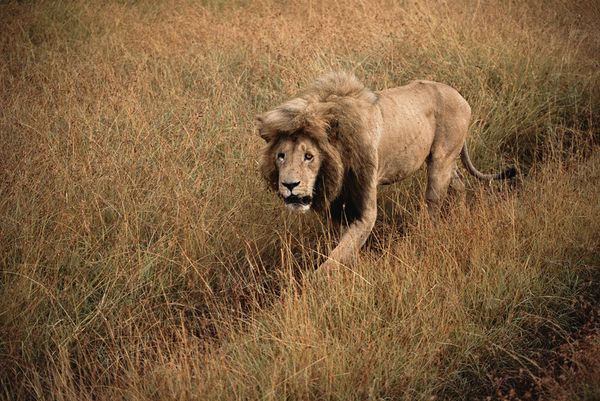
A male lion walks through golden grass on a savanna.
A male African lion prowls a savanna (file photo).
Photograph by Jodi Cobb, National Geographic

Five lions and a hyena have died after eating bait laced with poison in southern Kenya, wildlife advocates say.

Found on a community-owned ranch near a major national park, a bloody bucket streaked with purple stains suggests the animals were killed with a controversial pesticide that's become a conservationist's nightmare.

It's believed Maasai men, who live on the ranch and are traditionally nomadic herders, are responsible for the lion and hyena deaths. At least one Maasai herder has been arrested in connection with the crimes, according to Paula Kahumbu, head of the Nairobi, Kenya-based conservation group WildlifeDirect.

In southern Kenya months of drought have heightened long-standing tensions between wild predators and Maasai people.

(See "Elephants Fall to Drought in Kenya's Amboseli Park.")

As arid conditions make food and water harder to obtain, livestock become ever more valuable to both their owners—and to neighboring predators.

The poisoning occurred on April 2 at the Olgulului Group Ranch near Amboseli National Park, Kahumbu said.

Kahumbu received the news from the Kenya Wildlife Service, which had been alerted by a resident of the ranch, where lions were said to have killed two cows several days earlier.

The luridly stained bucket, she said, probably contained the laced bait. The type of bait, though is unknown, as no trace of it remained.

(WildlifeDirect receives some funding from the National Geographic Society, which owns National Geographic News.)

Kahumbu said test results had not yet arrived but that she believes the pesticide Furadan was used in the poisonings. Sold by Philadelphia-based FMC Corporation, Furadan is a trade name for carbofuran, a highly toxic, odorless pesticide, which comes in purple granules.

Though FMC maintains that Furadan is safe if used properly, the company stopped selling the substance in Kenya and neighboring Uganda and Tanzania after numerous reports emerged in 2008 that herders were using the pesticide to kill lions and other large predators.

(Related: "Lions, Hippos Poisoned in Famous Kenya Park.")

In Kenya the company quickly launched a buyback program. But two years later, conservationists say Furadan lingers on some store shelves.

"Although you can't find Furadan in the main shops, I don't think they withdrew it from some of the main outlying areas," Kahumbu said. "We know that some dealers are selling it by the spoonful."

(Also see: "Boy Dies After Eating Lion-Killing Pesticide, Dad Says.")

Ban Furadan?

Conservationists are pressing the Kenyan government to ban Furadan, because they don't believe the government has the resources to regulate its use. Many farmers see the pesticide as a way to kill birds, rats, dogs, and large predators.
"The issue is really whether a country has the capacity to educate its people to handle this safely," said Oliver Nasirwa, the Kenya-waterbirds officer for Wetlands International. "That's the problem for Kenya and most developing countries."

It seems to be a problem in developed countries too. In 2006 the U.S. Environmental Protection Agency banned the pesticide after ruling that Furadan posed an unreasonable risk to the environment, particularly birds. Carbofuran is also banned throughout Europe.

"Communities Are Pissed Off"

Olgulului Group Ranch has been part of an experimental program by which local Maasai herders are reimbursed if lions or other predators kill livestock such as cattle, for which the payment can equal about U.S. $200 a head. (Related: Maasailand lions fund.)

That program has struggled during the drought as Maasai herders in the area grew more intolerant of livestock losses, even with the compensation program in place.

"Apparently the communities are pissed off," WildlifeDirect's Kahumbu said.

"They're not getting what they think is the real value through the compensation scheme," which she noted is technically a "consolation" program. "The full value of the lost animal is not replaced, but a token amount is given to say, Sorry for your loss."

Compensation projects generally have community support and are still among the few viable options for protecting wildlife from aggrieved livestock owners, Kahumbu said.

"Compensation schemes have worked in the past but are extremely
vulnerable to fail under extreme situations, like the drought, when just
one individual can rile up an angry mob and undermine years of work," she said. By: Nick Wadhams in Nairobi, Kenya for National Geographic News

New "Roadrunner" Dinosaur Found in China

Nicknamed the roadrunner, the tiny dinosaur is one of the smallest and leggiest Alvarezsaurs ever to have roamed the Earth.


A new dinosaur species unearthed in China would have given Wile E. Coyote a run for his money.
Alvarezsaurs are known for their long-legged bodies adapted for running, and the group has been linked to the larger dinosaur family that includes modern birds. (Related: "Smallest Dinosaur in North America Discovered.")

Remains of the newfound species, Xixianykus zhangi, were found last spring by a local farmer in China's Henan Province, around 250 miles (400 kilometers) south of Beijing. The dinosaur lived about 85 million years ago, during the late Cretaceous period.

Based on the partial fossil, scientists think the creature was around 1.5 feet (0.5 meter) long with 10-inch-long (25-centimeter-long) legs.

Among the roadrunner dinosaur's most notable features are very short upper legs compared with its lower legs and feet—extreme even among Alvarezsaurs.

"These proportions imply it could put great long strides in and move fast," said Dave Hone, a paleontologist based at the Chinese Academy of Sciences in Beijing who has been studying the skeleton.

Roadrunner Dinosaur Also an Ant Eater

Although the roadrunner's forelimbs were not preserved, the dinosaur most likely had the muscular arms and large claws associated with Alvarezsaurs—perfect for pulling apart termite mounds and ripping into logs in its hunt for juicy insect morsels.

Features of the fossil backbone and pelvis confirm that idea: "The front of the body is adapted not to twist, which saves energy when running and provides a brace for digging actions," Hone said.

In addition, scientists think the tiny dinosaur sported feathers, since many of its cousins have been found with preserved plumage. By: Kate Ravilious for National Geographic News